
Understanding Shop Costs and Pricing
By Rob Munro
One of the most common business-related questions we receive at AERA is whether we have a labor guide and price sheet, specifically, how much other shops are charging for a given job. At first, these seem like straightforward questions, but are they really? Let’s explore the complexities behind shop pricing and why understanding your own costs is critical to the success of your business.
Consider four different AERA members, each operating under their own unique conditions:
- Example #1 – A 10,000-square-foot shop specializing in performance engines in San Francisco, equipped with newer machinery, five machinists, a dyno, and does full engine assembly.
- Example #2 – A 25,000-square-foot shop in Utah with 10 machinists and modern equipment, focused solely on machine work for industrial diesel engines (no assembly).
- Example #3 – A 5,000-square-foot shop in South Texas with three machinists, older equipment, and a diverse workload, handling gas, diesel, and performance engines, as well as dealer jobs like flywheels and head resurfacing.
- Example #4 – A 2,500-square-foot home-based shop in Mississippi, owner-operated, using older equipment, with a focus exclusively on cylinder heads.
Read this article with all images in the digital issue of Engine Professional magazine https://engineprofessional.com/2025EPQ3/#p=68
Each shop differs in overhead, efficiency, and equipment age, which directly impacts turnaround time and pricing. For instance, shops with CNC machinery complete jobs faster and can operate unattended, but they have higher equipment costs. Likewise, location plays a role, rent in the Bay Area of California is significantly higher than in areas of South Texas. The reason I mention engine assembly in my examples is that those shops that assemble must factor in a higher warranty and liability factor into their costs. These variations mean there is no universal pricing guide that applies to all shops. Basing your rates on someone else’s pricing structure could lead to significant financial miscalculations.
Applying the “Rule of Thirds” to Your Pricing Strategy
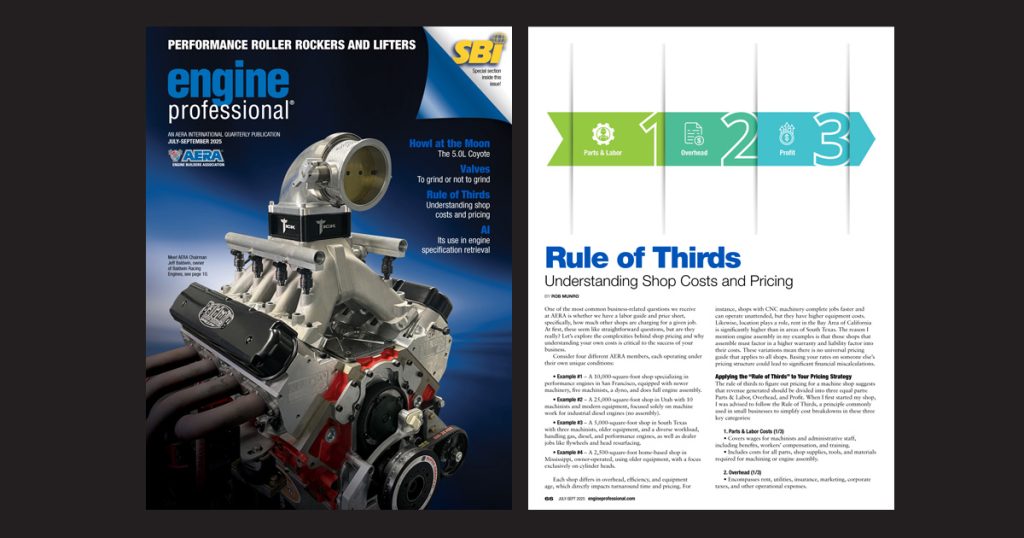
The rule of thirds to figure out pricing for a machine shop suggests that revenue generated should be divided into three equal parts: Parts & Labor, Overhead, and Profit. When I first started my shop, I was advised to follow the Rule of Thirds, a principle commonly used in small businesses to simplify cost breakdowns in these three key categories:
- Parts & Labor Costs (1/3)
• Covers wages for machinists and administrative staff, including benefits, workers’ compensation, and training.
• Includes costs for all parts, shop supplies, tools, and materials required for machining or engine assembly. - Overhead (1/3)
• Encompasses rent, utilities, insurance, marketing, corporate taxes, and other operational expenses. - Profit (1/3)
• The remaining revenue after covering all expenses. Your pricing must ensure a reasonable profit to maintain long-term business stability.
If you’ve never applied this method before, start small, use it to price your next few jobs to gain a clearer understanding of your shop’s financial structure.
Example Calculation: Chev 350 Block Boring
Here’s a practical example using current wages, rent, and expenses in my area. This involves cleaning and boring a Chev 350 block to .030” oversize on non-CNC equipment (with cam bearings and plugs already removed):
Parts & Labor Costs:
• $135.42 – 3.5 hours of machinist wages at $34.00 per hour, including employer costs (unemployment insurance, pension, workers’ compensation, vacation pay).
• $38.00 – Shop supplies (cleaning solution, honing oil, honing stones, cutters, plastic bags, etc.). This was calculated as 8% of labor costs, though it may need adjustment.
Overhead:
• $166.67 – Based on monthly operational costs of ($8,000), divided by 168 machinist working hours per month, then multiplied by 3.5 job hours.
Profit:
• $184.91 – The remaining third, ensuring profitability.
With these calculations, the total charge for this job is $525.00, setting an hourly door rate of $150.00. Once you get comfortable with cost calculations, begin evaluating employee productivity and ways to improve efficiency to further refine your pricing strategy. Even if many shop jobs have fixed pricing, it’s essential to calculate an hourly rate to ensure financial sustainability. Understanding profitability impacts your ability to invest in new equipment, attract investors, and potentially own your building rather than rent it.
Machinists work with numbers every day, the process in figuring out your costs and pricing is no different. Grab your calculator and give it a try!
The next step in optimizing profitability is automation, and the right computer software can be a game-changer. Real-time tracking of income and expenses ensures you know the cost of every job before it even arrives. Dedicated automotive machine shop software will help you stay competitive, adapt to industry changes, and continuously help you improve.
Read this article with all images in the digital issue of Engine Professional magazine https://engineprofessional.com/2025EPQ3/#p=68