
By Chuck Lynch
Is there a difference between tough and strong? Does it matter if there is or is not when it comes to pistons? Let us look at this comparison and then break down the needs of a few piston applications and answer that second question.
“Strong” refers to a material’s ability to withstand force without breaking or deforming permanently, while “tough” describes a material’s ability to absorb energy and withstand deformation, impact, or wear and tear before fracturing.
Read this article with all images in the digital issue of Engine Professional magazine https://engineprofessional.com/2025EPQ4/#p=18
Pistons are asked to do a lot of things in a rapidly changing environment. Think about the mnemonic device/phrase that we use to describe the four strokes of the four-cycle engine.
- Suck – The piston is a syphon to create an atmosphere that is under vacuum.
- Squeeze – The piston is a compression device to alter by reducing the volumetric area of the cylinder.
- Bang – The piston becomes the seal between the expanding gases of combustion and the connecting rod which drives the crankshaft turning linear motion into rotary motion.
- Blow – The piston now pushes the spent gases out of the cylinder.
The above process is the same regardless of the energy demand that is required of the engine. What is the “waste energy” of combustion? Heat. If you look at The Second Law of Thermodynamics it simply states that, in every real-world energy transfer or transformation, some amount of energy is converted into a form of energy that is unusable. In most cases, this unusable energy takes the form of heat. Side note: the automotive industry uses some waste heat for additional energy such as climate control, improving combustion efficiency, etc.
What does that have to do with tough vs. strong? All pistons are pretty tough as a rule. Advances in aluminum alloys have made aluminum the material of choice for many years. Although we have used cast iron for a period of time and we are currently using some steel alloys for pistons, we continue to develop the aluminum piston. This has resulted in a part that is quite the engineering masterpiece as these modern high energy output engines are demanding features like piston crown cooling, alfin bond Ni-resist ring inserts, anodized ring lands and anodized crowns, as well as a myriad of coatings that could be an article in its own right.
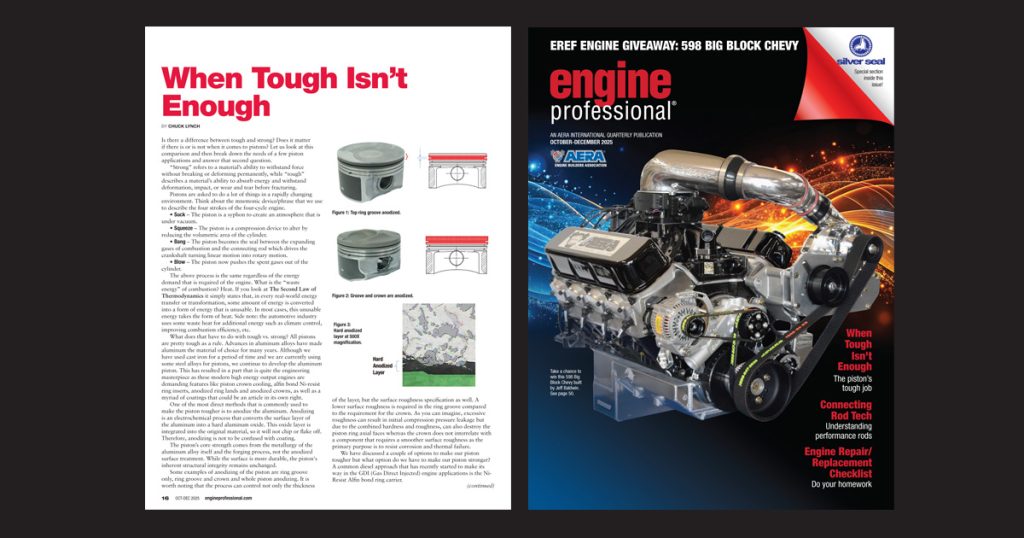
One of the most direct methods that is commonly used to make the piston tougher is to anodize the aluminum. Anodizing is an electrochemical process that converts the surface layer of the aluminum into a hard aluminum oxide. This oxide layer is integrated into the original material, so it will not chip or flake off. Therefore, anodizing is not to be confused with coating.
The piston’s core strength comes from the metallurgy of the aluminum alloy itself and the forging process, not the anodized surface treatment. While the surface is more durable, the piston’s inherent structural integrity remains unchanged.
Some examples of anodizing of the piston are ring groove only, ring groove and crown and whole piston anodizing. It is worth noting that the process can control not only the thickness of the layer, but the surface roughness specification as well. A lower surface roughness is required in the ring groove compared to the requirement for the crown. As you can imagine, excessive roughness can result in initial compression pressure leakage but due to the combined hardness and roughness, can also destroy the piston ring axial faces whereas the crown does not interrelate with a component that requires a smoother surface roughness as the primary purpose is to resist corrosion and thermal failure.
We have discussed a couple of options to make our piston tougher but what option do we have to make out piston stronger? A common diesel approach that has recently started to make its way in the GDI (Gas Direct Injected) engine applications is the Ni-Resist Alfin bond ring carrier.
Ni-Resist is a family of cast iron alloys that contain nickel, often in the range of 14-25%, along with other elements like chromium and copper. These alloys are known for:
- Excellent corrosion resistance
- Good thermal conductivity
- Dimensional stability at high temperatures
- Wear resistance
Why Use Ni-Resist in Pistons?
Ni-Resist inserts are commonly used in diesel engine pistons, especially in high-performance or heavy-duty applications, for the following reasons:
- Improved Strength and Durability: Ni-Resist materials can withstand high thermal and mechanical loads, which helps prevent cracking or deformation in the piston crown or ring groove areas.
- Thermal Management: the alloy’s thermal conductivity helps dissipate heat more effectively, reducing the risk of localized overheating.
- Wear Resistance: Ni-Resist inserts in ring grooves reduce wear from the constant friction of piston rings, extending the life of the piston.
- Dimensional Stability: Ni-Resist maintains its shape and size under high temperatures, which is critical for maintaining tight tolerances in engine operation.
The process that is required to manufacture a ring carrier into the piston is critical to the durability of the assembly. The Alfin bonding process involves preparing a Ni-Resist or austenitic cast iron insert, which is then dipped into a molten Al-Si (aluminum-silicon) alloy at high temperatures to form an intermetallic layer of Fe-Al-Si phases between the two metals. After the immersion, the insert is placed into a mold, and the remaining molten aluminum alloy is poured around it to cast a piston. This creates a strong, bimetallic bond for the top ring groove in high-performance diesel engine pistons, enhancing wear resistance.
The following segment describes the process casting and Alfin Bond piston.
- Preparation of the Insert
• Surface Treatment: The cast iron ring carrier (insert) is prepared through mechanical treatment like shot peening and sand blasting to ensure a pure and rough surface, which is essential for a good bond.
• Heating: The insert is heated to remove any moisture, a critical step before the immersion process. - The Alfin Immersion
• Dipping: The prepared cast iron insert is submerged in a bath of molten Al-Si alloy for a specific period.
• Intermetallic layer formation: During this immersion, atoms diffuse between the iron and aluminum, forming a durable intermetallic compound layer, primarily Fe-Al-Si phases. This layer is the key to the strong connection. - Casting the Piston
• Placement in the mold: The Alfin-treated ring carrier is placed into a preheated metallic mold.
• Pouring the Alloy: The rest of the aluminum alloy is then poured into the mold, surrounding the insert.
• Cooling and Machining: The casting cools and solidifies, creating the piston with the integrated ring carrier. The piston then undergoes machining to achieve its final shape.
There are other means of strengthening pistons in the area of casting and forging features that could be discussed as well but with the ring carrier being a fairly recent option for the GDI pistons coupled with anodized piston crowns, I felt that there was an opportunity to express how we are bridging the gap between gas/petrol and diesel engines.
Many parts in the engine are required to have a balance between toughness and strength. Think about induction hardening of a crankshaft radius, an exhaust valve with a Stellite face, or a cam lobe and lifter. There is that fine balance that increases overall durability. No different than a human that needs to grow their mental toughness by studying/learning and exercising your body for physical strength.
AERA has many resources beyond just service data. If you are ever curious as to how a part is manufactured and what the critical to quality factors are, please reach out to the team and we will share the information we currently have, or we will seek out the information and learn together.
Dale Carnegie once stated that “Knowledge is not power until it’s applied”. That is the goal of the Engine Professional magazine…to provide application driven content that makes you and your team stronger. Thanks for reading.
Read this article with all images in the digital issue of Engine Professional magazine https://engineprofessional.com/2025EPQ4/#p=18