
By Francisco Aristizabal
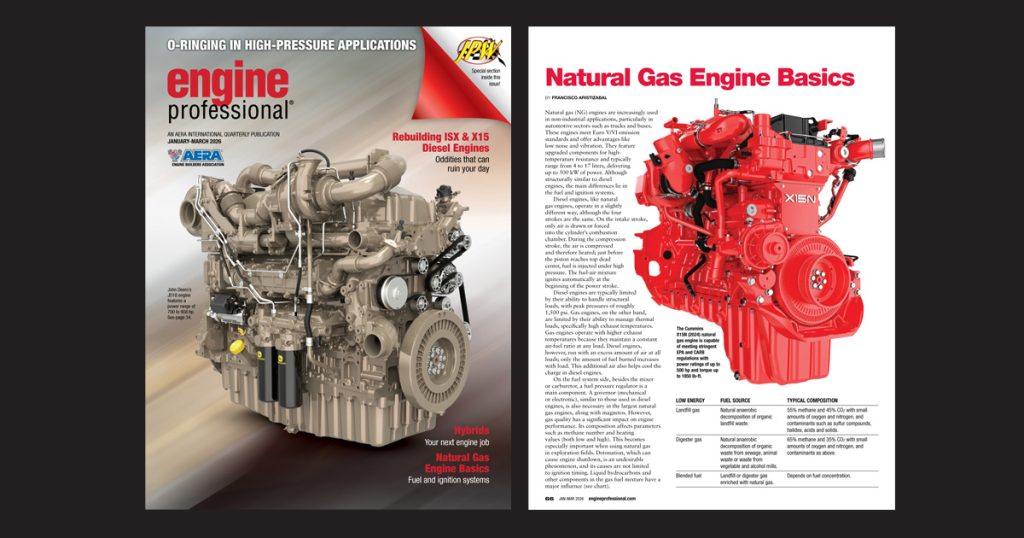
Natural gas (NG) engines are increasingly used in non-industrial applications, particularly in automotive sectors such as trucks and buses. These engines meet Euro V/VI emission standards and offer advantages like low noise and vibration. They feature upgraded components for high-temperature resistance and typically range from 4 to 17 liters, delivering up to 500 kW of power. Although structurally similar to diesel engines, the main differences lie in the fuel and ignition systems.
Diesel engines, like natural gas engines, operate in a slightly different way, although the four strokes are the same. On the intake stroke, only air is drawn or forced into the cylinder’s combustion chamber. During the compression stroke, the air is compressed and therefore heated; just before the piston reaches top dead center, fuel is injected under high pressure. The fuel-air mixture ignites automatically at the beginning of the power stroke.
Read this article with all images in the digital issue of Engine Professional magazine https://engineprofessional.com/2026EPQ1/#p=68
Diesel engines are typically limited by their ability to handle structural loads, with peak pressures of roughly 1,500 psi. Gas engines, on the other hand, are limited by their ability to manage thermal loads, specifically high exhaust temperatures. Gas engines operate with higher exhaust temperatures because they maintain a constant air-fuel ratio at any load. Diesel engines, however, run with an excess amount of air at all loads; only the amount of fuel burned increases with load. This additional air also helps cool the charge in diesel engines.
On the fuel system side, besides the mixer or carburetor, a fuel pressure regulator is a main component. A governor (mechanical or electronic), similar to those used in diesel engines, is also necessary in the largest natural gas engines, along with magnetos. However, gas quality has a significant impact on engine performance. Its composition affects parameters such as methane number and heating values (both low and high). This becomes especially important when using natural gas in exploration fields. Detonation, which can cause engine shutdown, is an undesirable phenomenon, and its causes are not limited to ignition timing. Liquid hydrocarbons and other components in the gas fuel mixture have a major influence (see chart).
Detonation produces severe pressures and temperatures that may affect not only spark plug temperatures but also impose significant stress on insulators, electrodes, pistons, valves, bearings, and other engine components.
In the ignition system, electronic ignition systems were designed to replace traditional magneto systems. Electronic ignition eliminates the magneto and other components subject to mechanical wear, while also providing enhanced diagnostic and troubleshooting capabilities. However, magnetos are still widely used. A magneto is an alternating current generator that produces electrical energy, timed precisely, for spark ignition engines. Ignition transformers for each cylinder are also necessary to increase the voltage from either the magneto or the electronic ignition system, enabling a spark to jump across the spark plug electrodes. Although spark plugs are the smallest components in the system, they are among the most critical for engine performance due to their direct role in ignition.
The ignition system must be capable of supplying the voltage necessary to create a spark between the spark plug electrodes. In practice, this requires a substantial “ignition reserve” to compensate for normal wear of spark plugs and other ignition components. Ignition reserve is defined as the difference between the voltage available (Va) from the ignition system and the voltage required (Vr) by the spark plug. If at any point Vr equals Va, a misfire will likely occur (see image above).
The temperature and condition of spark plug electrodes are key factors to consider in the design and selection of spark plugs. Voltage requirements decrease as electrode temperatures rise and increase as temperatures fall. Sharp, new electrodes concentrate the spark arc by providing an easier path for current flow. As new plugs with well-defined electrodes wear, the voltage required for ignition increases. Changes in electrode materials must also be considered, ranging from traditional copper/nickel to advanced materials such as platinum, iridium, and gold-palladium, in descending order of voltage requirements.
As always, this information is intended to serve as a general guide. Specific details may vary depending on the equipment manufacturer and application. Always consult the manufacturer’s literature and other OEM service materials. The AERA Tech Line is also available to assist with questions on these matters.
Read this article with all images in the digital issue of Engine Professional magazine https://engineprofessional.com/2026EPQ1/#p=68