
By Andy Kennedy
When it comes to machining diesel blocks and heads, some can be quite difficult and hard to handle. For instance, a Cummins 1710 bare block weighs around 1500 lbs. This can cause potentially dangerous situations when handling blocks of this size. You need to make sure your cranes and lifting straps are rated for this kind of weight.
Having the equipment to machine these types of engine blocks is normally a lot more expensive than automotive sized equipment. Therefore, the bill to machine these heavy-duty application engine components can also be quite expensive. For instance, the Cummins 1710 can cost upwards of $5,000 to clean, magnaflux, surface, align bore and replace upper and lower repair inserts. Most shops usually want to stick with machines capable of machining engine components under 10 to 11 liters in size.
Read this article with all images in the digital issue of Engine Professional magazine https://engineprofessional.com/2026EPQ1/#p=76
Let’s look at some of the more common diesel engines member shops are working on.
Paccar MX13
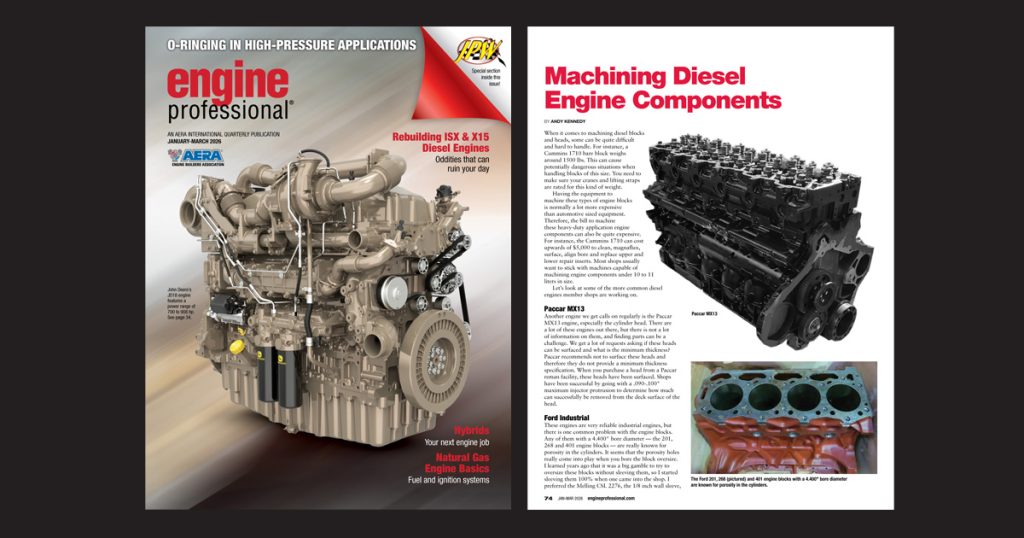
Another engine we get calls on regularly is the Paccar MX13 engine, especially the cylinder head. There are a lot of these engines out there, but there is not a lot of information on them, and finding parts can be a challenge. We get a lot of requests asking if these heads can be surfaced and what is the minimum thickness? Paccar recommends not to surface these heads and therefore they do not provide a minimum thickness specification. When you purchase a head from a Paccar reman facility, these heads have been surfaced. Shops have been successful by going with a .090-.100″ maximum injector protrusion to determine how much can successfully be removed from the deck surface of the head.
Ford Industrial
These engines are very reliable industrial engines, but there is one common problem with the engine blocks. Any of them with a 4.400″ bore diameter — the 201, 268 and 401 engine blocks — are really known for porosity in the cylinders. It seems that the porosity holes really come into play when you bore the block oversize. I learned years ago that it was a big gamble to try to oversize these blocks without sleeving them, so I started sleeving them 100% when one came into the shop. I preferred the Melling CSL 2276, the 1/8 inch wall sleeve, and leaving a shelf at the bottom of the cylinder. Reliance Power Parts also offers a flanged repair sleeve for these — FD7NN6055B for the finished bore sleeve and F161174 for the semi-finished repair sleeve. It seems that once these blocks are sleeved, it fixes any issues with porosity.
John Deere 404 and 466
While most shops recondition or at least check the big end housing bore on the connecting rods for these engines, I have found over the years that the big end housing bore is .0015-.002″ tighter than the OEM specification; this is something to watch out for. Even though the rod bearings and the crankshaft journals still looked good when the engine was taken apart, it’s a good idea to have the customer bring in the rods when they are doing an overhaul. Otherwise, when re-assembling the engine and torquing up the rods, the engine will lock up. I have seen this numerous times over the years, especially when I just sold an engine kit and maybe all they brought into the shop was the head.
If you’ve been thinking about taking in more industrial diesel engine components to machine, give us a call on the AERA tech line at 888-324-2372.We have the experience and information at our fingertips to walk you through the process, and to help you avoid any costly mistakes.
Read this article with all images in the digital issue of Engine Professional magazine https://engineprofessional.com/2026EPQ1/#p=76