
By Charles Navarro
2025 saw changing headwinds when it comes to electrification of motor vehicles, with a downturn in EV sales and market share, with some forecasts showing declines up to 40% in certain markets forecasted by S&P Global and other analysts. There are many reasons cited for this change – from change of consumer demands to loss of EV credits, but most forecasts now suggest – the internal combustion engine is here to stay. In the 2019 SAE Automotive Engineering article “Extending the ICE Age”, the author explored the ongoing relevance of the internal combustion engine amid electrification, with the ICE (internal combustion engine) engine sticking around for decades to come. 2019 IHS data stated that in 10 years we’d still see 90% of vehicles having an ICE – as of 2024, BEV (battery-electric vehicle) models make up 7-8% of new vehicle sales, a figure that has remained relatively flat into 2025.
Read this article with all images in the digital issue of Engine Professional magazine https://engineprofessional.com/2026EPQ1/#p=58
Even manufacturers that went all in on electric have since reversed course. According to a Harvard policy brief on the EV tax credit elimination, the free market shift towards alternatives to EVs will likely favor HEV (hybrid), PHEVs (plug-in hybrid), and EREVs (extended range EV). The brief even quoted Ford and Nissan as predicting the collapse of the EV market, pushing towards mixed-powertrain models. GM has trimmed its EV bets, doubling down on production of models with gas engines, like their hugely popular Equinox, and cancelling their BrightDrop EV. Even states like California are facing federal blocks and re-assessing the 2035 ban on new gas car sales.
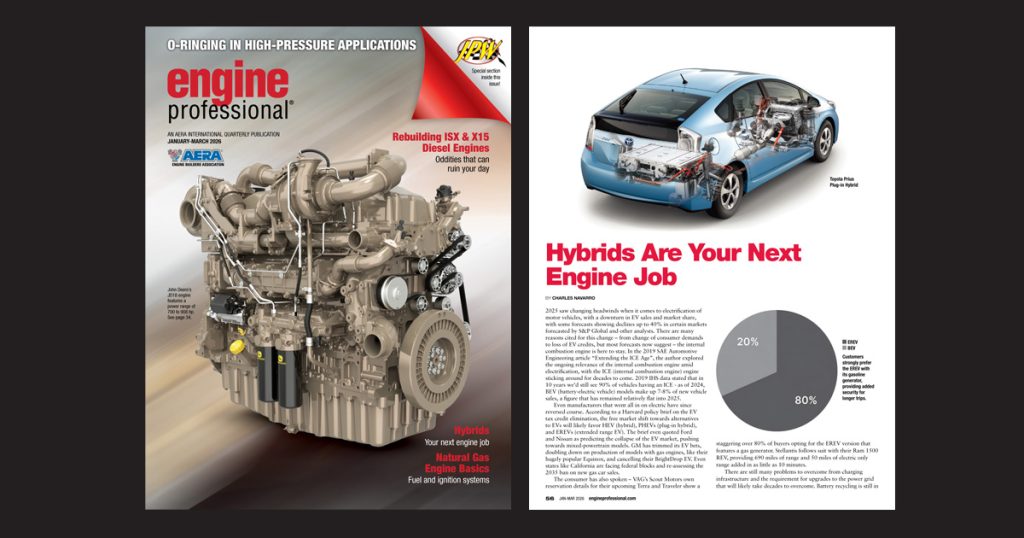
The consumer has also spoken – VAG’s Scout Motors own reservation details for their upcoming Terra and Traveler show a staggering over 80% of buyers opting for the EREV version that features a gas generator. Stellantis follows suit with their Ram 1500 REV, providing 690 miles of range and 50 miles of electric only range added in as little as 10 minutes.
There are still many problems to overcome from charging infrastructure and the requirement for upgrades to the power grid that will likely take decades to overcome. Battery recycling is still in its infancy, though advancements are progressing, as is battery technology itself. Considering the volatility of the rare earth metals supply chain, before we can achieve widespread acceptance of EVs, we need to continue to develop battery technology and how these batteries are best utilized. Again, Toyota is the leader here. First, Toyota’s “1:6:90 Rule” defines their EV strategy: one EV could build 6 PHEVs or 90 HEVs, yielding greater carbon reductions from higher hybrid volumes, providing the much needed bridge to electrification. Toyota’s solid state battery tech provides greater safety, high energy density, faster charging, and longer life, with projections of upwards of 90% capacity after 40 years compared to 64% after 20 years with current battery technology. Toyota’s CTO, Hiroki Nakajima, has gone as far as to say that Toyota wants to be the ‘last company’ making engines. That’s good for all of us – meaning their gasoline engines will likely need rebuilding well before the electric drivetrain ages out.
Beyond these technological challenges, the human element is critical. Outside of the infancy of this technology, it’s the shortage of technicians that is plaguing the automotive industry. Ford still can’t fill 5,000 mechanic jobs. TechForce said between 2024 and 2029 there would be a need for over 1 million transportation technician jobs. The Bureau of Labor Statistics said some 70,000 openings mostly are replacement demand from retirements, bringing to light another issue – training. Ford says it takes five years of learning to know what you are doing. There are also some things that factory training or trade schools can’t replace – tribal knowledge, passed down from experienced mechanics. We all know people who are in their 70s or older looking for an exit or who are planning on working until the very end, most without anyone to fill their shoes. This knowledge needs to be preserved and passed onto future generations, meaning we need to support youth joining the automotive field with apprenticeships and mentoring.
This also extends to those of us already in the trade needing to learn about hybrid drivetrains and how to work on them. Speaking to those on the front line gives us a clear picture of the state of things. I was granted the opportunity to speak to several “in the know” at Court Street Ford, in Bourbonnais, IL. In speaking to their master hybrid and EV tech, I found him quite pragmatic. He started through the Ford Asset Program and chose to go this route with his career because “a lot of people are against it… So I figured if I get good at it … I can make more money that way.” In his opinion, learning to work with high-voltage systems is the path forward for those who want to stay relevant in the industry (and why I’m writing this article). Although his personal preference is for hybrids for the improved fuel economy, he did say that “it’s going to be really hard to persuade people to get them if they are so hard against them. But I feel like if you let them drive them, I think they will likely like them.” Most of the issues he sees with EVs aren’t associated with the batteries and can be resolved with software updates. Even with hybrids, most of the issues are with the ICE engine, not the electric side of the hybrid drivetrain. It’s clear that we don’t all have to drive a BEV, but HEV, PHEV, and EREV technologies are here to stay, so why not learn to live with them, and make money doing so?
We can’t be good sellers of these things if we can’t also be good at servicing them.” — Brandon Chiro, Court Street Ford’s Sales Manager
To gauge the temperature of the industry, it’s important to look at the legacy automakers. For example, as of publication, Ford is actively considering cancellation or pausing production on the Ford Lightning. In 2024, their EV division lost $5.1 billion and is projected to lose $5.5 billion in 2025. We all know that if we ran our businesses like that, they wouldn’t survive for long. Ford is planning a shift in 2027 to EREV models of the Explorer, Expedition, and Super Duty, reflecting market realities for more affordable models with flexible range considering the high cost of large EV batteries for bigger vehicles. The GMC Hummer EV’s battery tips the scales at nearly 3000 pounds, heavier than many small cars – that’s enough to make 11-15 PHEV or 130-236 HEV models. Ford currently offers HEVs and plans to expand hybrid powertrains across its entire North American fleet by the end of the decade. Brandon sees EVs as a growing, still-maturing technology that co-exists with ICE vehicles, rather than replacing them. “There’s an engine for every buyer- from the old school 5.0 to the hybrid 3.5” … to the Lightning EV. With over 16 years of experience, Brandon sees hybrids as “training wheels” for both consumers and dealerships (and their service departments), “easing them into this whole thing of electric cars.” EVs are not for everyone, but “sometimes you just have to get behind the wheel.” Brandon says that education and experience are keys to wider acceptance. Kimberly Most, a Sales Specialist with Ford, a Mach-E owner, and a fellow car enthusiast, sums it up nicely – “The Mach-E gives me that same thrill – it takes me back to my teenage years” driving muscle cars, valuing convenience, performance, and affordability over ideology, with “hybrids” being the “smartest option.”
I wouldn’t call myself an early adopter of these technologies, however I do see them as one way to make sure that when they do try to kill off the ICE, that maybe they’ll let us keep and hopefully drive our gassers. BEVs have their place – urban and suburban commuting, especially with lots of stop-and-go driving, where there is home/workplace charging access to allow convenient charging, and fleet operations planned around dedicated charging infrastructure and predicable routes. However, you’ll never see me take a cross-country drive in a BEV and many don’t see a BEV replacing the ICE for long distance driving, especially towing and hauling. That’s where HEV, PHEV, and EREV models bridge that gap. In our extended family, we have both an Escape HEV and PHEV. Like with our MachE, both are well designed and built, making the transition to these new technologies painless and practical. I agree with Brandon, who says it best — “If you were to tell someone 15 years ago that the most powerful and fuel efficient F-150 would be a hybrid, they wouldn’t have believed you.” Working on them will likely just require us to adapt and overcome. Independent shops already have legal paths to OEM service info and programming. Start using the factory service sites and J2534 today so you can touch modern hybrid powertrains with confidence. Begin with one high-voltage safety class and a basic hybrid overview—enough to power down a car safely and read the data. From there, practice on a bench inverter/contactor and follow a simple flow: verify concern, scan, test, fix, and finally re-verify. But at the core of it, the ICE side of a HEV or PHEV is still dictated by the four cycles of the internal combustion engine – intake, compression, power, and exhaust, so there’s no reason why they can’t and won’t need rebuilding for decades to come. And that’s where we all step in. As ICE evolves in hybrids, our expertise ensures we’re not just surviving, but thriving.
Read this article with all images in the digital issue of Engine Professional magazine https://engineprofessional.com/2026EPQ1/#p=58