
By Chuck Lynch
The engine rebuilding industry has long been a great example of being conscientious recyclers. We kind of pioneered the Green Movements as we have always tried to save as many resources as possible to repair and reuse high value resources. Technology has both helped and hindered that movement.
Areas where technology has helped us with the recycling process is in the measurement and machining processes that ensure that we produce a high quality “recycled” product. We have access to measuring devices that can help to validate surface finishes, hardness, coatings, thickness of castings, dimensional tolerances and so on.
Read this article with all images in the digital issue of Engine Professional magazine https://engineprofessional.com/2025EPQ3/#p=18
The areas where technology has worked against us in our industry of recycling has been in the ability to better predict just how much material is actually needed to make a part live a scheduled amount of time before failure as well as utilize no more material than is necessary for the production of components to ensure that it is one time use only. This is quite common with electronic devices like sensors, solenoids, etc.
An increasingly common question that we are asked on the tech line is whether “X” valve can be reground. Today, many valves are manufactured using super alloys, or the part may have special coating or heat treatment processes that make the valve not serviceable or at least it will not perform as intended.
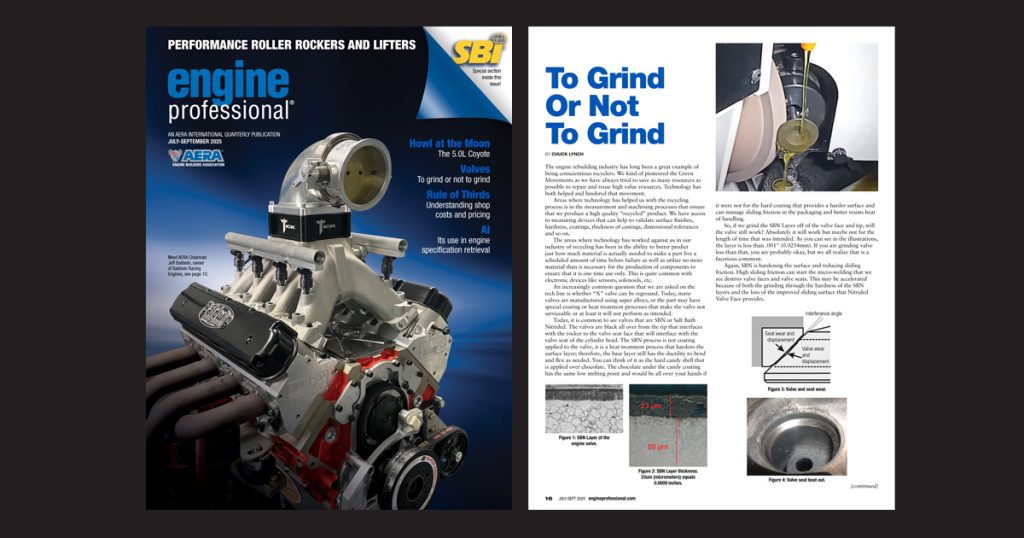
Today, it is common to see valves that are SBN or Salt Bath Nitrided. The valves are black all over from the tip that interfaces with the rocker to the valve seat face that will interface with the valve seat of the cylinder head. The SBN process is not coating applied to the valve, it is a heat treatment process that hardens the surface layer; therefore, the base layer still has the ductility to bend and flex as needed. You can think of it as the hard candy shell that is applied over chocolate. The chocolate under the candy coating has the same low melting point and would be all over your hands if it were not for the hard coating that provides a harder surface and can manage sliding friction in the packaging and better resists heat of handling.
So, if we grind the SBN Layer off of the valve face and tip, will the valve still work? Absolutely it will work but maybe not for the length of time that was intended. As you can see in the illustrations, the layer is less than .001″ (0.0254mm). If you are grinding valve less than that, you are probably okay, but we all realize that is a facetious comment.
Again, SBN is hardening the surface and reducing sliding friction. High sliding friction can start the micro-welding that we see destroy valve faces and valve seats. This may be accelerated because of both the grinding through the hardness of the SBN layers and the loss of the improved sliding surface that Nitrided Valve Face provides.
Other factors that were stated earlier are materials like Stellite facing that are not applied as heavily as they once were. In the past, the parts were much larger, and we seemed to “build in extra material” that allowed for service. Here are some examples of what Stellite used to look like when applied.
Today, we seldom see margins on valve heads that allow for grinding in addition to the above-mentioned reasons. When we are dealing with minimal amounts of material, you have to consider this old analogy, “The same heat that hardens the egg, softens the potato.” That said, you want to consider the number of thermal cycles these valves have endured, are the valves utterly worth saving?
I have spent many years in this industry and want it to continue. But as recyclers, we have to continue to grow our knowledge and be critical thinkers. We must use the knowledge that we gain to help us make logical, data driven decisions about re-using certain components. Some valves are acceptable to re-grind, and some are not worth the risk. Hopefully, some of the above information will help you make that decision and help to educate your customers when they ask why you recommend new valves.
Read this article with all images in the digital issue of Engine Professional magazine https://engineprofessional.com/2025EPQ3/#p=18