
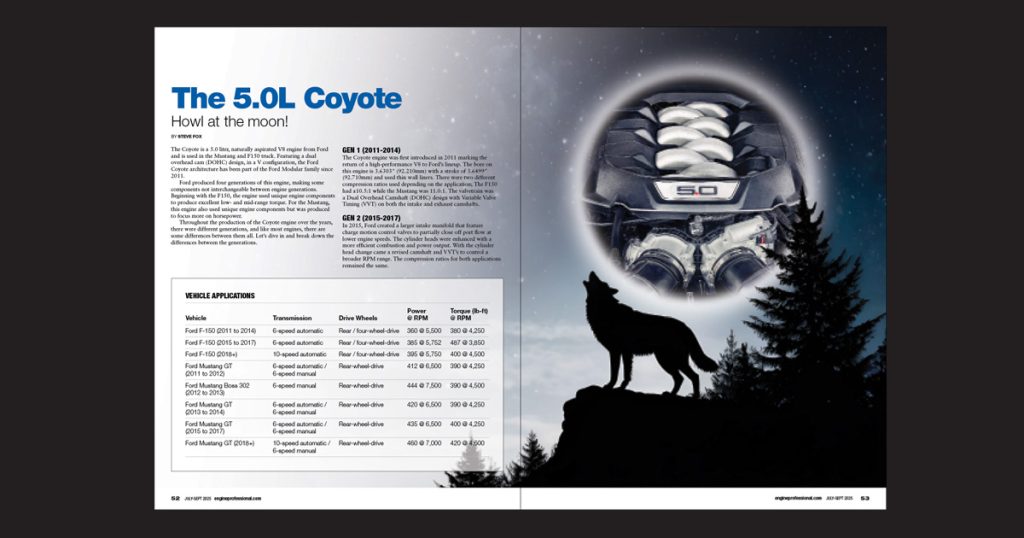
Howl at the moon!
By Steve Fox
The Coyote is a 5.0 liter, naturally aspirated V8 engine from Ford and is used in the Mustang and F150 truck. Featuring a dual overhead cam (DOHC) design, in a V configuration, the Ford Coyote architecture has been part of the Ford Modular family since 2011.
Ford produced four generations of this engine, making some components not interchangeable between engine generations. Beginning with the F150, the engine used unique engine components to produce excellent low- and mid-range torque. For the Mustang, this engine also used unique engine components but was produced to focus more on horsepower.
Throughout the production of the Coyote engine over the years, there were different generations, and like most engines, there are some differences between them all. Let’s dive in and break down the differences between the generations.
Read this article with all images in the digital issue of Engine Professional magazine https://engineprofessional.com/2025EPQ3/#p=54
GEN 1 (2011-2014)
The Coyote engine was first introduced in 2011 marking the return of a high-performance V8 to Ford’s lineup. The bore on this engine is 3.6303″ (92.210mm) with a stroke of 3.6499″ (92.710mm) and used thin wall liners. There were two different compression ratios used depending on the application; The F150 had a10.5:1 while the Mustang was 11.0:1. The valvetrain was a Dual Overhead Camshaft (DOHC) design with Variable Valve Timing (VVT) on both the intake and exhaust camshafts.
GEN 2 (2015-2017)
In 2015, Ford created a larger intake manifold that feature charge motion control valves to partially close off port flow at lower engine speeds. The cylinder heads were enhanced with a more efficient combustion and power output. With the cylinder head change came a revised camshaft and VVT’s to control a broader RPM range. The compression ratios for both applications remained the same.
GEN 3 (2018-2020 F150 & 2018-Current Mustang)
These engines used a higher compression ratio that increased to 12.0:1, enhancing the power output and efficiency of the engine. The Gen 3 engines featured dual fuel high pressure direct injection with low-pressure fuel injection. Previous generations of this engine only had one port injection. Also, an upgrade was larger intake and exhaust valves.
GEN 4 (2021-Current F150)
The power output on this engine was approximately 400 HP and 410 pound-feet of torque. Compression ratio on this generation of engine did not change from the previous and remailed at 12.0:1. A couple major changes that did occur was the addition of the cylinder deactivation and the heads were redesigned with a cam carrier. Another change was the oil pump that became a variable displacement with a carbon fiber belt drive. Essentially every casting and internal part is different on the Generation 4 engine.
With everything, you make one change and more than likely something else must change. Well, that is no different with the Coyote engine. Depending on the generation of engine that was used and application, there were changes made and attention to detail should be paid to make sure that you are using the correct components.
We will dive into some of the differences of the components depending on the generation and application.
CYLINDER BLOCKS
GEN 1 Block
- Utilizes aluminum to reduce weight and improve efficiency.
- Replaceable cast iron cylinder bore liners.
- Same deck height and bore spacing as its 4.6L predecessor block.
Deck Height: 8.9370″ (227 mm)
Bore Spacing: 3.9370″ (100 mm) - Piston cooling jets (except the Boss application).
- Originally it had 12×190 mm head bolts, and the replacement blocks have 11×130 mm head bolts.
GEN 2 Block
- Updated and improved casting.
- •Addition of oil galleries used for Smart OFA on the F150 applications. Smart OFA allows oil pressure to drop when the engine is not under a load and improves fuel mileage.
- Still used the replaceable cast iron liners.
- 11×130 mm head bolts.
GEN 3 Block
- Plasma Wire Arc Transfer (PWTA) cylinder liner – no more cast iron liners.
- Increased the bore diameter from 3.6303″ (92.210 mm) to 3.6618″ (93.010 mm) while the stroke remained the same, 3.6499″ (92.710 mm).
- Deck height remained 8.9370″ (227 mm).
- Start/Stop technology was introduced and used coated bearings.
PISTONS
- GEN 1 Pistons shown below: F-150 left; Mustang right.
- GEN 2 Pistons shown below: F-150 left (carry over from Gen 1); Mustang right.
- GEN 3 Piston: F-150 and Mustang shown below.
CRANKSHAFTS AND CONNECTING RODS
GEN 1 Crankshaft and Connecting Rods
- Forged steel crankshaft
- Graded Main Bearings in .0003″(.008 mm) increments.
- Balance difference between F-150 and Mustang applications.
- This balance difference is the result of application unique piston design. Part number etched into the front counterweight – F150 = BL3E-6300-** and Mustang = BR3E-6300-**
- Forged powder metal rods
GEN 2 Crankshaft and Connecting Rods
- Forged steel crankshaft
- Graded Main Bearings in .0003″ (.008 mm) increments.
- Balance difference between F-150 and Mustang applications due to updated piston design for Generation 2 engines. Part number etched into the front counterweight – F150 = FL3E-6300-** and Mustang = FR3E-6300-**
- Forged powder metal rods updated and improved from Generation 1 with reduced weight and a modified metallurgy to add strength.
GEN 3 Crankshaft and Connecting Rods
- Forged steel crankshaft
- Balance difference between F-150 and Mustang applications due to updated piston design for Generation 3 engines. Part number etched into the front counterweight – F150 and Mustang use the JR3E-6300-** casting number.
- Forged powder metal rods carried over from Generation 2 engines.
CYLINDER HEADS
GEN 1 Cylinder Head
- The BR3E head casting has a narrow intake flange.
- DOHC design with 4 valves per cylinder.
- F-150 and Mustang use the same head design.
- Oil Restrictor in head gasket.
GEN 2 Cylinder Head
- FL3E or FR3E have a wider intake flange.
- Improved intake and exhaust air flow.
- Unique exhaust valve angles for the FR3E Mustang heads – from 60/90/120 degrees to 60/100/120 degrees.
- Oil Restrictor plug driven in cylinder head.
GEN 3 Cylinder Head
- Heads were redesigned to incorporate direct injection.
- Direct injection ports cast into the cylinder head.
- High pressure fuel pump pedestal added to the right head and is cam driven.
- Valves and valve seat diameters increased in size to improve air flow.
- Casting improved and now using AS7GU material.
CAMSHAFTS
GEN 1 Camshaft
- Unique intake camshafts for F-150 and Mustang applications. The F-150 has a prefix of BL3E on the camshafts, and the Mustang has a BR3E prefix.
- Both applications use the same exhaust camshafts with a prefix of BR3E
GEN 2 Camshaft
- Camshaft lobe profiles changed from Generation 1 engines to improve horsepower and torque.
- Unique intake and exhaust camshaft for the F-150 with a prefix of FL3E and the Mustang has a prefix of FR3E.
GEN 3 Camshaft
- Again, the camshaft lobe profiles were changed to improve horsepower and torque.
- Unique intake and exhaust camshaft for the F-150 with a prefix of JL3E and the Mustang has a prefix of JR3E.
- Added a 3-point lobe on the right exhaust camshaft to drive the high-pressure fuel pump needed for the direct injection.
TIMING COMPONENTS
There was not much change in the timing components between Generation 1-3, though there are some. The Generation 1 timing chain is a little bit wider and longer than the Generation 2 and 3 chain. Also, the tensioner changed from a cast tensioner in Generation 1 to an aluminum tensioner used in Generation 2 and 3. The VVT changed also to a mid-lock design for Generation 2 engines.
This information can be very helpful in determining which gernational design engine you have and what to look out for when rebuilding the Coyote engine. AERA would like to thank Jasper Engines for the information provided in this article, without their help, this would not have been possible.
Read this article with all images in the digital issue of Engine Professional magazine https://engineprofessional.com/2025EPQ3/#p=54