
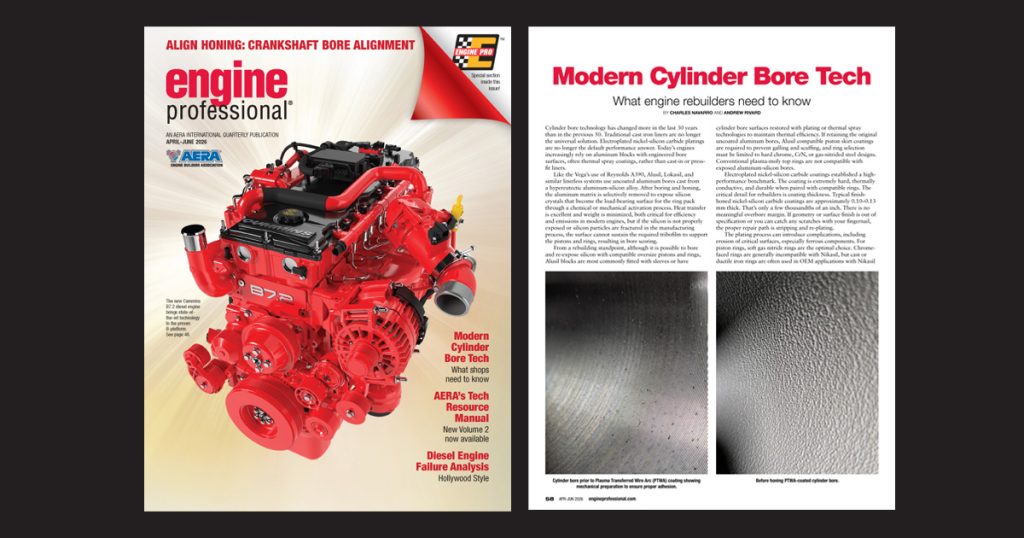
What engine rebuilders need to know
By Charles Navarro and Andrew Rivard
Cylinder bore technology has changed more in the last 30 years than in the previous 50. Traditional cast iron liners are no longer the universal solution. Electroplated nickel-silicon carbide platings are no longer the default performance answer. Today’s engines increasingly rely on aluminum blocks with engineered bore surfaces, often thermal spray coatings, rather than cast-in or press-fit liners.
Like the Vega’s use of Reynolds A390, Alusil, Lokasil, and similar linerless systems use uncoated aluminum bores cast from a hypereutectic aluminum-silicon alloy. After boring and honing, the aluminum matrix is selectively removed to expose silicon crystals that become the load-bearing surface for the ring pack through a chemical or mechanical activation process. Heat transfer is excellent and weight is minimized, both critical for efficiency and emissions in modern engines, but if the silicon is not properly exposed or silicon particles are fractured in the manufacturing process, the surface cannot sustain the required tribofilm to support the pistons and rings, resulting in bore scoring.
Read this article with all images in the digital issue of Engine Professional magazine https://engineprofessional.com/2026EPQ2/#p=60
From a rebuilding standpoint, although it is possible to bore and re-expose silicon with compatible oversize pistons and rings, Alusil blocks are most commonly fitted with sleeves or have cylinder bore surfaces restored with plating or thermal spray technologies to maintain thermal efficiency. If retaining the original uncoated aluminum bores, Alusil compatible piston skirt coatings are required to prevent galling and scuffing, and ring selection must be limited to hard chrome, CrN, or gas-nitrided steel designs. Conventional plasma-moly top rings are not compatible with exposed aluminum-silicon bores.
Electroplated nickel-silicon carbide coatings established a high-performance benchmark. The coating is extremely hard, thermally conductive, and durable when paired with compatible rings. The critical detail for rebuilders is coating thickness. Typical finish-honed nickel-silicon carbide coatings are approximately 0.10–0.13 mm thick. That’s only a few thousandths of an inch. There is no meaningful overbore margin. If geometry or surface finish is out of specification or you can catch any scratches with your fingernail, the proper repair path is stripping and re-plating.
The plating process can introduce complications, including erosion of critical surfaces, especially ferrous components. For piston rings, soft gas nitride rings are the optimal choice. Chrome-faced rings are generally incompatible with Nikasil, but cast or ductile iron rings are often used in OEM applications with Nikasil bores. Standard or high tension rings are also not compatible with Nikasil, requiring low-tension oil control rings. Low-tension ring strategies used with Nikasil can produce oil consumption characteristics different from traditional higher-tension rings run on iron cylinder bores.
Many OEMs have reduced their reliance on electroplating not because it does not work, but because of manufacturing realities. Wet chemical processes carry environmental and waste-handling burdens. Dry thermal spray systems integrate more easily into high-volume production and eliminate plating bath complexity. That shift in manufacturing philosophy is one reason OEMs and rebuilders alike are now seeing far more sprayed ferrous bores in the field.
Most modern aluminum blocks now rely on a thin ferrous coating applied by thermal spray. The goal is to replicate cast iron’s tribological behavior while retaining aluminum’s weight and heat-transfer advantages. Coating thickness is typically on the order of 0.1 mm, similar to electroplated bores. However with thermal sprays you can apply the coating much thicker than you otherwise could with other technologies, allowing for significant buildup to correct for damage, distortion, or wear. Modern spray bores are often finished to an aggressive plateau or mirror-like surface, as small friction reductions translate directly into fuel economy and emissions gains. Spray bores are one of the cleaner ways to achieve that goal.
Where conventional liners require an interference fit in aluminum blocks due to dissimilar expansion rates, thermal spray coatings get away from this by using a grooved surface that creates a mechanical interlock once the molten steel droplets solidify. When properly executed, the coating bond is both metallurgical and mechanical. Cross-sections of APS and PTWA bores clearly show the coating interlocking into the prepared aluminum substrate. Guhring, who makes the grooving tool for bore prep, also offers a laser roughening process that achieves a similar result. In some systems, grit blasting and application of a metallic bond coat precede deposition of the iron-based wear layer.
Plasma Transferred Wire Arc (PTWA) is one of the most widely deployed variants. A steel wire is melted by a plasma arc, atomized, and deposited onto a prepared aluminum bore. After deposition, the surface is diamond-finished to establish final geometry and plateau structure. Ford has deployed PTWA in production V8 programs, and the Coyote is a well-known example of an all-aluminum engine with PTWA-coated cylinder bores. Ford has publicly described the PTWA implementation as improving durability and heat transfer while reducing friction. That combination of friction reduction and robustness is the real driver behind industry adoption. Similarly, Nissan also uses PTWA, but honed to a mirror bore finish to achieve very low friction operation, relying solely on the coating porosity to support proper lubrication of the piston/cylinder system. Originally associated with the GT-R program, the process was developed into a scalable production technology used across multiple Nissan platforms.
Porsche also uses PTWA in its 718, 991.2, and later horizontally opposed engines.
Atmospheric Plasma Spray (APS) systems, including Oerlikon’s SUMEbore, use powder feedstock rather than wire. Powder flexibility allows tailored alloy chemistry and fine control over microstructure and porosity. SUMEbore has been deployed across a broad range of automotive and powersports engines, including VW/Audi/Porsche V8 engines.
Wide acceptance of APS and PTWA illustrate an important point: thermal spray is not a niche technology. It is now a production solution across multiple segments.
OEM programs using thin iron-based plasma spray bores (PTWA/APS) have developed piston ring technologies engineered for these surfaces. HVOF-applied cermet top rings, such as MAHLE’s HV385-class coatings, were designed to operate against these thin thermal spray liners. Their dense microstructure, high bond strength, and scuff resistance make them well suited for the boundary lubrication conditions present near top dead center (TDC), particularly in high specific-output engines.
Under the elevated cylinder pressures of forced induction, the ring-to-liner interface experiences increased loading, higher contact stress, and reduced oil film thickness. In controlled tribological testing simulating severe TDC loading, PTWA liners paired with CrN-faced steel top rings demonstrated exceptionally low wear rates and strong friction stability. For extremely high specific-output boosted applications, CrN-faced steel rings represent a conservative and highly robust top ring choice. Conventional plasma-moly top rings are not appropriate in this application.
Importantly, available data also indicate that the liner material itself has a greater influence on wear behavior than the ring coating alone. Iron-based plasma spray bores have demonstrated consistent and predictable wear characteristics across multiple modern ring technologies, providing greater flexibility in ring selection compared to earlier aluminum-silicon and electroplated nickel-silicon carbide coatings.
Surface finish measurement on both Nikasil and plasma spray cylinder bores requires careful interpretation. Most builders utilize a handheld profilometer such as the Mitutoyo SJ-210 equipped with a 5 micron stylus tip. While adequate for conventional cast iron surfaces, larger stylus tips can bridge narrow valleys and under-report true valley depth, especially on porous thermal spray coated bores. A 2 micron stylus tip combined with TraceBoss software using robust filtering, rather than standard Gaussian filtering, resolves more of the true surface structure. Because porosity appears to the profilometer as deep, isolated valleys, it can significantly influence parameters such as Rvk and Rz, depending on filtering method and cutoff selection.
Two additional considerations matter. First, proper surface preparation prior to measurement is essential. Residual honing debris, including torn or folded material, as well as general contamination, can throw off profilometer readings. As with Nikasil, plasma spray bores must be thoroughly cleaned before profilometry to avoid erroneous data interpretation, as honing debris can and does hide in valleys and in the exposed porosity. Surface finish values from different stylus geometries and filtering strategies are not directly interchangeable.
In addition, honing media condition plays a significant role in surface finish consistency on both Nikasil and plasma spray bores. Unlike cast iron, these harder surfaces can load stones more quickly, particularly during finish passes. Once loaded, stones tend to smear rather than cut, potentially closing porosity in spray coatings or altering silicon exposure in plated or AlSi surfaces. Frequent stone cleaning and monitoring of cutting action are necessary for consistent results from cylinder to cylinder.
Nikasil, PTWA, APS/SUMEbore, and related spray systems share a fundamental limitation: coating thickness in the ~0.1 mm class. There is effectively no overbore margin. If the bore is compromised, recoating is the proper path, but if geometry and surface finish is correct, engines can safely be re-ringed. If you aren’t sure what the surface finish was when an engine was new, simply check the bore out of ring travel at or below BDC. Regardless, a simple visual inspection of cylinder bores won’t tell you the whole story or guarantee a successful rebuild.
As the industry adapts, collaboration between engine builders, tribologists, and testing organizations becomes increasingly important. Ongoing aftermarket work by companies such as Renndienst Solutions and Total Seal, including validation of surface finish and ring compatibility through independent testing by SPEEDiagnostix’s Lake Speed Jr. (The Motor Oil Geek), Digital Metrology’s Mark Malburg, and Southwest Research Institute’s Peter Lee, reflects the direction the trade is moving. Understanding how modern ring packs and lubricants interact with these thin coatings allows rebuilders to make service decisions based on data rather than guesswork.
These technologies are not experimental. They are proven production solutions used across domestic and international platforms. The responsibility of the modern engine builder is not to replace them with older architecture, but to understand them well enough to service them correctly.
Read this article with all images in the digital issue of Engine Professional magazine https://engineprofessional.com/2026EPQ2/#p=60