
By Brian Roberts
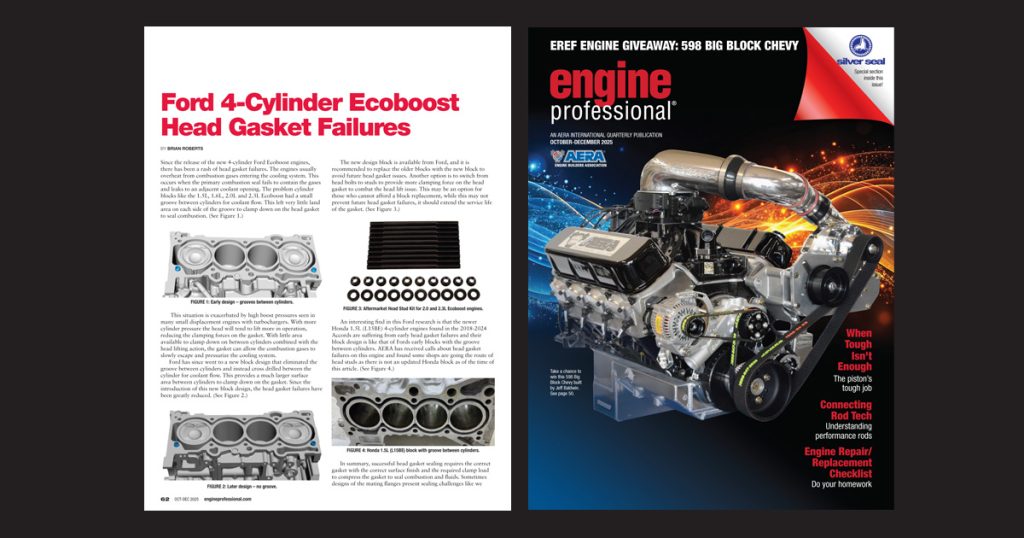
Since the release of the new 4-cylinder Ford EcoBoost engines, there has been a rash of head gasket failures. The engines usually overheat from combustion gases entering the cooling system. This occurs when the primary combustion seal fails to contain the gases and leaks to an adjacent coolant opening. The problem cylinder blocks like the 1.5L, 1.6L, 2.0L and 2.3L EcoBoost had a small groove between cylinders for coolant flow. This left very little land area on each side of the groove to clamp down on the head gasket to seal combustion. (See Figure 1: Early design – grooves between cylinders)
This situation is exacerbated by high boost pressures seen in many small displacement engines with turbochargers. With more cylinder pressure the head will tend to lift more in operation, reducing the clamping forces on the gasket. With little area available to clamp down on between cylinders combined with the head lifting action, the gasket can allow the combustion gases to slowly escape and pressurize the cooling system.
Read this article with all images in the digital issue of Engine Professional magazine https://engineprofessional.com/2025EPQ4/#p=64
Ford has since went to a new block design that eliminated the groove between cylinders and instead cross drilled between the cylinder for coolant flow. This provides a much larger surface area between cylinders to clamp down on the gasket. Since the introduction of this new block design, the head gasket failures have been greatly reduced. (See Figure 2: Later design – no groove)
The new design block is available from Ford, and it is recommended to replace the older blocks with the new block to avoid future head gasket issues. Another option is to switch from head bolts to studs to provide more clamping force on the head gasket to combat the head lift issue. This may be an option for those who cannot afford a block replacement, while this may not prevent future head gasket failures, it should extend the service life of the gasket. (See Figure 3: Aftermarket Head Stud Kit for 2.0 and 2.3L EcoBoost engines)
An interesting find in this Ford research is that the newer Honda 1.5L (L15BE) 4-cylinder engines found in the 2018-2024 Accords are suffering from early head gasket failures and their block design is like that of Fords early blocks with the groove between cylinders. AERA has received calls about head gasket failures on this engine and found some shops are going the route of head studs as there is not an updated Honda block as of the time of this article. (See Figure 4: Honda 1.5L (L15BE) block with groove between cylinders)
In summary, successful head gasket sealing requires the correct gasket with the correct surface finish and the required clamp load to compress the gasket to seal combustion and fluids. Sometimes designs of the mating flanges present sealing challenges like we see here. I hope members find this information useful when encountering head gasket failures on the Ford EcoBoost 4-cylinder engines or the newer Honda 1.5L (L15BE) engine.
Read this article with all images in the digital issue of Engine Professional magazine https://engineprofessional.com/2025EPQ4/#p=64