
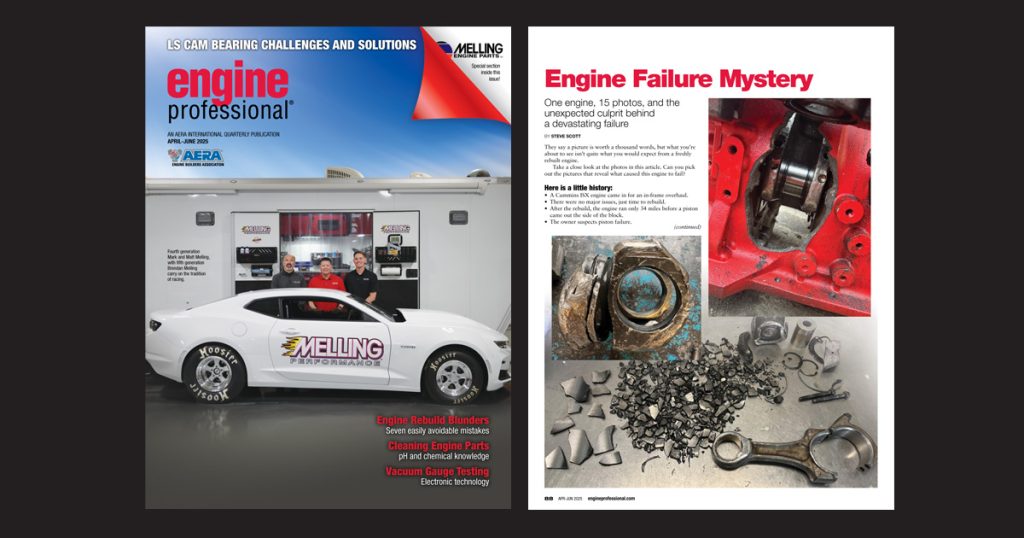
One engine, 15 photos, and the unexpected culprit
behind a devastating failure
By Steve Scott
They say a picture is worth a thousand words, but what you’re about to see isn’t quite what you would expect from a freshly rebuilt engine.
Take a close look at the photos in this article. Can you pick out the pictures that reveal what caused this engine to fail?
Here is a little history:
- A Cummins ISX engine came in for an in-frame overhaul.
- There were no major issues, just time to rebuild.
- After the rebuild, the engine ran only 34 miles before a piston came out the side of the block.
- The owner suspects piston failure.
Read this article with all images in the digital issue of Engine Professional magazine https://engineprofessional.com/2025EPQ2/#p=90
Now put on your detective hat, or just trust your instincts, and see if you can uncover the culprit. These pictures are all you’ve got. Once you identify the cause, you might find yourself wondering, “How could that happen?” or “Who would let this slip by?” But remember, metal doesn’t lie. The facts are right in front of you. It’s time to figure out the mystery.
Still Looking?
Well, it’s not a lot to work with, is it? There is one component that tells the story and timeline of this failure. So, let’s start by narrowing things down and eliminating some possibilities.
First up, pictures #3 and #4 show significant damage to the piston, but there is no evidence of piston failure. This is secondary impact damage. So, we can rule out piston failure as the root cause.
Next, let’s look at picture #8. This one shows the connecting rod bushing has spun and extruded from the rod eye (small end). While this would create excessive clearance and allow the piston to contact the cylinder head, it doesn’t fully explain the condition of the other components. So, the rod bushing isn’t the culprit, either.
The answer is in picture number…
Notice pictures #7 and #9. This is where the real story starts to unfold. These images tell everything we need to know about the timeline of the failure.
Here’s what we can conclude:
One rod bolt is still in place – but it’s bent, as though the rod cap had been pried (hinged) open.
Two other rod bolts are straight. The threads are polished but not stripped or pulled. They’re not necked (stretched), and there’s no major impact damage on the heads.
So, what happened?
Here’s the sequence of events that the images support:
- The two straight rod bolts worked their way out of the rod.
- This allowed the rod bearing (big end) to spin, which blocked the oil passage in the connecting rod that supplies oil to the rod bushing (small end).
- The thickness of the rod bearing shell (big end) suggests that the rod cap opened far enough for the bearing shell to exit (it was flattened in the later stages of failure).
- Without lubrication, the rod, piston pin and piston would seize very quickly.
- The spun and extruded bushing in the small end of the rod created excessive clearance causing the piston to impact the cylinder head, causing the piston to go off-axis
- ISX engines use a mid-stop liner, meaning there is no support at the bottom of the liner. At the bottom of the stroke, the piston starts flailing around and quickly shatters the liner.
- With no liner to contain it, the piston is free to break through the side of the cylinder block.
What’s incredible here is that the rod bearing (big end) shows so little damage. For the bearing shell to exit, the connecting rod cap had to hinge open, and for the bolts to remain straight, they couldn’t have remained in place at all.
So, here we are — 15 pictures and a detailed timeline, all pointing to a catastrophic chain of events set off by a single missing detail: at least two improperly installed rod bolts. It’s amazing how a simple, but major oversight can destroy an engine.
And as for the 696 words, well, I guess I need to work on my photography skills. Maybe next time, I’ll get a few more pictures — but then again, sometimes the truth is hidden in plain sight.
Read this article with all images in the digital issue of Engine Professional magazine https://engineprofessional.com/2025EPQ2/#p=90