
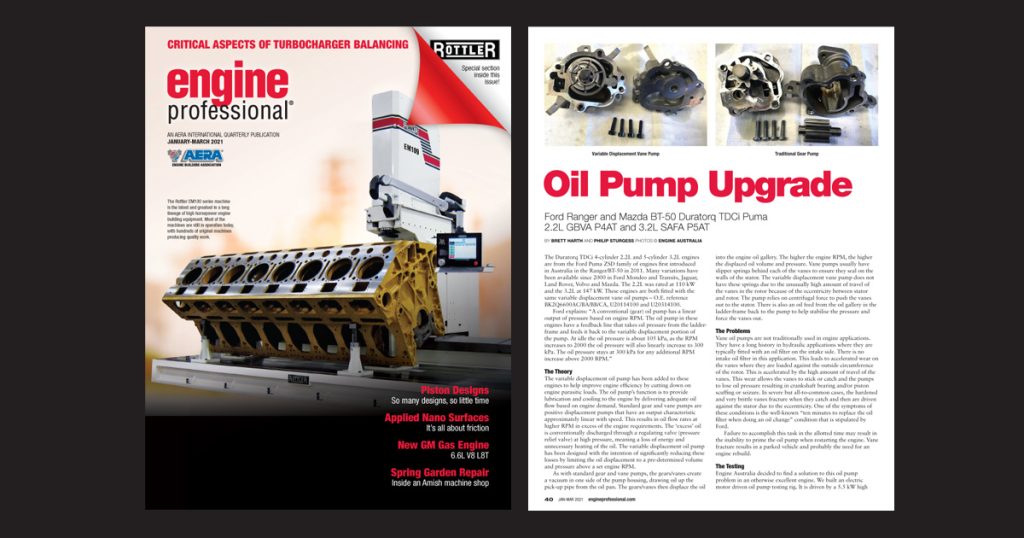
Ford Ranger and Mazda BT-50 Duratorq TDCi Puma 2.2L GBVA P4AT and 3.2L SAFA P5AT
By Brett Harth and Philip Sturgess
The Duratorq TDCi 4-cylinder 2.2L and 5-cylinder 3.2L engines are from the Ford Puma ZSD family of engines first introduced in Australia in the Ranger/BT-50 in 2011. Many variations have been available since 2000 in Ford Mondeo and Transits, Jaguar, Land Rover, Volvo and Mazda. The 2.2L was rated at 110 kW and the 3.2L at 147 kW. These engines are both fitted with the same variable displacement vane oil pumps – O.E. reference BK2Q6600AC/BA/BB/CA, U20114100 and U20314100.
Ford explains: “A conventional (gear) oil pump has a linear output of pressure based on engine RPM. The oil pump in these engines have a feedback line that takes oil pressure from the ladder-frame and feeds it back to the variable displacement portion of the pump. At idle the oil pressure is about 105 kPa, as the RPM increases to 2000 the oil pressure will also linearly increase to 300 kPa. The oil pressure stays at 300 kPa for any additional RPM increase above 2000 RPM.”
Read this article with all images in the digital issue of Engine Professional magazine https://engineprofessional.com/2021EPQ1/#p=42
The Theory
The variable displacement oil pump has been added to these engines to help improve engine efficiency by cutting down on engine parasitic loads. The oil pump’s function is to provide lubrication and cooling to the engine by delivering adequate oil flow based on engine demand. Standard gear and vane pumps are positive displacement pumps that have an output characteristic approximately linear with speed. This results in oil flow rates at higher RPM in excess of the engine requirements. The ‘excess’ oil is conventionally discharged through a regulating valve (pressure relief valve) at high pressure, meaning a loss of energy and unnecessary heating of the oil. The variable displacement oil pump has been designed with the intention of significantly reducing these losses by limiting the oil displacement to a pre-determined volume and pressure above a set engine RPM.
As with standard gear and vane pumps, the gears/vanes create a vacuum in one side of the pump housing, drawing oil up the pick-up pipe from the oil pan. The gears/vanes then displace the oil into the engine oil gallery. The higher the engine RPM, the higher the displaced oil volume and pressure. Vane pumps usually have slipper springs behind each of the vanes to ensure they seal on the walls of the stator. The variable displacement vane pump does not have these springs due to the unusually high amount of travel of the vanes in the rotor because of the eccentricity between stator and rotor. The pump relies on centrifugal force to push the vanes out to the stator. There is also an oil feed from the oil gallery in the ladder-frame back to the pump to help stabilise the pressure and force the vanes out.
The Problems
Vane oil pumps are not traditionally used in engine applications. They have a long history in hydraulic applications where they are typically fitted with an oil filter on the intake side. There is no intake oil filter in this application. This leads to accelerated wear on the vanes where they are loaded against the outside circumference of the rotor. This is accelerated by the high amount of travel of the vanes. This wear allows the vanes to stick or catch and the pumps to lose oil pressure resulting in crankshaft bearing and/or piston scuffing or seizure. In severe but all-to-common cases, the hardened and very brittle vanes fracture when they catch and then are driven against the stator due to the eccentricity. One of the symptoms of these conditions is the well-known “ten minutes to replace the oil filter when doing an oil change” condition that is stipulated by Ford.
Failure to accomplish this task in the allotted time may result in the inability to prime the oil pump when restarting the engine. Vane fracture results in a parked vehicle and probably the need for an engine rebuild.
The Testing
Engine Australia decided to find a solution to this oil pump problem in an otherwise excellent engine. We built an electric motor driven oil pump testing rig. It is driven by a 5.5 kW high speed balanced electric motor, capable of 6000 RPM. We have fitted high accuracy Stauss pressure and Macnaught flow gauges, and a Techtop AC variable speed drive and controller. We tested the O.E. variable displacement pump at 800, 1000 up to 5000 RPM (in 250 RPM increments), recording oil pressure, flow rate and engine power at each marker. We then tested a suitable replacement gear pump at the same settings and recorded the same data. We then ran the motor without the oil pump connected and recorded the power requirements of the electric motor at each marker. These values were subtracted from the previously recorded values at the equivalent markers to determine the drive power of only the oil pumps. The data from both pumps has been tabulated and graphed and is shown below.
The Results
The test results verify that the variable displacement vane pump consumes less power than its gear driven equivalent. In normal driving conditions the engine would rarely see more than 2500 RPM – maybe the occasional 3000 RPM. Highway cruising and typical driving will usually be less than 2000 RPM. At 2000 RPM the extra power draw for the gear pump is 0.47 kW, at 2500 RPM 0.71 kW and at 3000 RPM 0.95 kW. The small loss in engine power is far outweighed by the benefits to the engine from increased oil flow and oil pressure. By replacing the O.E. vane pump with a gear pump, you increase the reliability of your engine and do not have to be concerned about the “10 minute oil change” rule or engine failure due to oil pump failure.
Diesel Performance Parts offers a direct replacement gear driven oil pump to replace the O.E. variable displacement vane oil pump. It has all the benefits of increased oil flow and pressure across the full RPM range, with a very small power penalty in the normal operating range. The gear pump is a must for performance applications due to its increased oil flow and pressure.
Read this article with all images in the digital issue of Engine Professional magazine https://engineprofessional.com/2021EPQ1/#p=42