
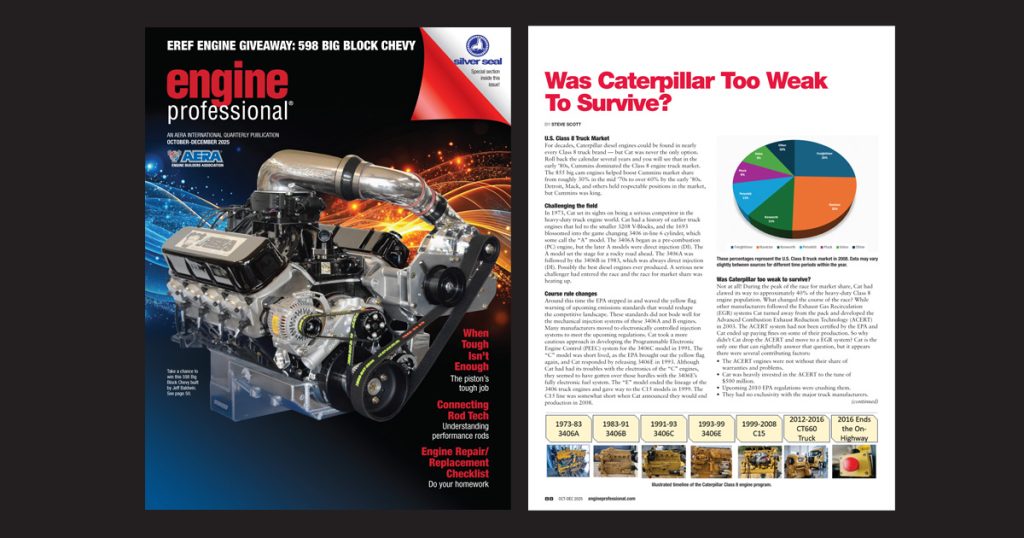
By Steve Scott
U.S. Class 8 Truck Market
For decades, Caterpillar diesel engines could be found in nearly every Class 8 truck brand — but Cat was never the only option. Roll back the calendar several years and you will see that in the early ’80s, Cummins dominated the Class 8 engine truck market. The 855 big cam engines helped boost Cummins market share from roughly 30% in the mid ’70s to over 60% by the early ’80s. Detroit, Mack, and others held respectable positions in the market, but Cummins was king.
Challenging the field
In 1973, Cat set its sights on being a serious competitor in the heavy-duty truck engine world. Cat had a history of earlier truck engines that led to the smaller 3208 V-Blocks, and the 1693 blossomed into the game changing 3406 in-line 6 cylinder, which some call the “A” model. The 3406A began as a pre-combustion (PC) engine, but the later A models were direct injection (DI). The A model set the stage for a rocky road ahead. The 3406A was followed by the 3406B in 1983, which was always direct injection (DI). Possibly the best diesel engines ever produced. A serious new challenger had entered the race and the race for market share was heating up.
Read this article with all images in the digital issue of Engine Professional magazine https://engineprofessional.com/2025EPQ4/#p=90
Course rule changes
Around this time the EPA stepped in and waved the yellow flag warning of upcoming emissions standards that would reshape the competitive landscape. These standards did not bode well for the mechanical injection systems of these 3406A and B engines. Many manufacturers moved to electronically controlled injection systems to meet the upcoming regulations. Cat took a more cautious approach in developing the Programmable Electronic Engine Control (PEEC) system for the 3406C model in 1991. The “C” model was short lived, as the EPA brought out the yellow flag again, and Cat responded by releasing 3406E in 1993. Although Cat had had its troubles with the electronics of the “C” engines, they seemed to have gotten over those hurdles with the 3406E’s fully electronic fuel system. The “E” model ended the lineage of the 3406 truck engines and gave way to the C15 models in 1999. The C15 line was somewhat short when Cat announced they would end production in 2008.
Was Caterpillar too weak to survive?
Not at all! During the peak of the race for market share, Cat had clawed its way to approximately 40% of the heavy-duty Class 8 engine population. What changed the course of the race? While other manufacturers followed the Exhaust Gas Recirculation (EGR) systems Cat turned away from the pack and developed the Advanced Combustion Exhaust Reduction Technology (ACERT) in 2003. The ACERT system had not been certified by the EPA and Cat ended up paying fines on some of their production. So why didn’t Cat drop the ACERT and move to a EGR system? Cat is the only one that can rightfully answer that question, but it appears there were several contributing factors:
- The ACERT engines were not without their share of warranties and problems.
- Cat was heavily invested in the ACERT to the tune of $500 million.
- Upcoming 2010 EPA regulations were crushing them.
- They had no exclusivity with the major truck manufacturers.
Repositioning
While Cat had around 40% of this on-highway market, it was only around 10% of their total income. Combine that with the 2008 financial crisis and their dropping stock prices, the writing was on the wall. They chose to step away from the on-highway engine market, but not out of weakness. They made a business decision to refocus their resources on what they did best — Off Highway. Caterpillar has a proven track record of being a global dominating power in the construction, mining, marine, power generation, forestry industries. The Class 8 engine business had become a costly distraction.
White Flag – One More Lap
Sometimes it’s hard to give up on a bad idea. In 2012, Cat partnered with Navistar to develop a Cat vocational truck. Some of these trucks were produced with the Cat CT15 engines, which still did not meet the EPA standards and again cost them in fines. Additionally, other trucks were produced with less powerful engine options. To many, this was a black eye for Cat and they ended their truck program in 2016.
The Legacy Lives On
Cat may have exited the race, but the engines live on. Engine rebuilding, repairs, and machine work are still amazingly strong and aftermarket part sales for these engines are still in high demand. AERA’s PROSIS program reports the Cummins ISX and Cat C15 inquiries continually compete for being the top engine searches. If you thought these have faded into the abyss, you are missing opportunities for service and parts sales. Cat engine owners and operators have a strong bond to these 3406 and C15 models and are fighting hard to keep them on the road. Cat didn’t go to the pits under the checkered flag, and these loyal fans are not leaving the asphalt any time soon. Production dates, release dates, and market share vary by opinion or resources, but there are still opportunities in these aging engines.
Read this article with all images in the digital issue of Engine Professional magazine https://engineprofessional.com/2025EPQ4/#p=90