
By Chuck Lynch
Magazine articles, like novels, are more than words on paper or a screen. They are a glimpse into the personality of the author. We who like to read, find authors with a style that resonates with us individually. At PRI this past December this subject came up during our EPIC Program at a break between sessions and I have had some recent emails and phone calls about an article that I recently penned that really enforced that thought and that is why I opened with these comments and will let that lead me into the real topic of this article.
So…I am a curious person when it comes to manufacturing just about anything. I remember when “How it’s made” was released and I thought, “What a great idea!” As I wander around the many roads, small and large towns, I see product names that I recognize and I think that is a place I would like to tour and get a better understanding of that product and what are the critical features, processes, materials and what kind of people are behind the processes.
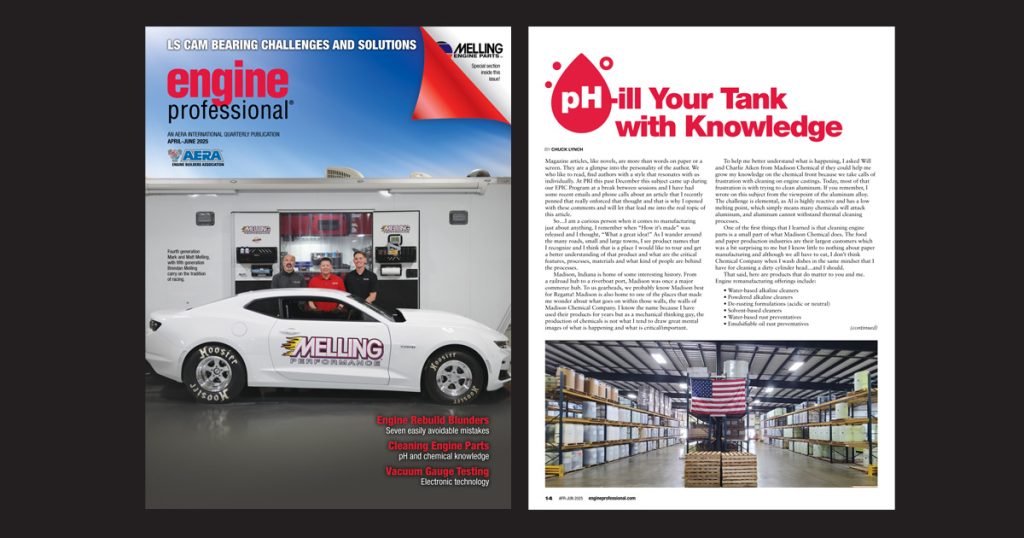
Read this article with all images in the digital issue of Engine Professional magazine https://engineprofessional.com/2025EPQ2/#p=16
Madison, Indiana is home of some interesting history. From a railroad hub to a riverboat port, Madison was once a major commerce hub. To us gearheads, we probably know Madison best for Regatta! Madison is also home to one of the places that made me wonder about what goes on within those walls, the walls of Madison Chemical Company. I know the name because I have used their products for years but as a mechanical thinking guy, the production of chemicals is not what I tend to draw great mental images of what is happening and what is critical/important.
To help me better understand what is happening, I asked Will and Charlie Aiken from Madison Chemical if they could help me grow my knowledge on the chemical front because we take calls of frustration with cleaning on engine castings. Today, most of that frustration is with trying to clean aluminum. If you remember, I wrote on this subject from the viewpoint of the aluminum alloy. The challenge is elemental, as Al is highly reactive and has a low melting point, which simply means many chemicals will attack aluminum, and aluminum cannot withstand thermal cleaning processes.
One of the first things that I learned is that cleaning engine parts is a small part of what Madison Chemical does. The food and paper production industries are their largest customers which was a bit surprising to me but I know little to nothing about paper manufacturing and although we all have to eat, I don’t think Chemical Company when I wash dishes in the same mindset that I have for cleaning a dirty cylinder head…and I should.
That said, here are products that do matter to you and me. Engine remanufacturing offerings include:
- Water-based alkaline cleaners
- Powdered alkaline cleaners
- De-rusting formulations (acidic or neutral)
- Solvent-based cleaners
- Water-based rust preventatives
- Emulsifiable oil rust preventatives
Any facility that can custom tailor chemicals for your needs is going to have a laboratory.
What does that mean to a customer? The ability to evaluate the following:
- Alkalinity/acidity analysis – tank solution analysis
- Fourier transform infrared (FTIR) spectroscopy – organic soil analysis
- High-Performance Liquid Chromatography (HPLC) – solvent/surfactant analysis
- Full-scale washers – realistic product development testing
- Water analysis – Metals (ICP-OES) and pH
- Oil and grease
- The chemistry of cleaning products, as follows:
- Basic chemistry of water-based alkaline cleaning products:
– pH scale
– Alkalinity - Typical components
- Environmental, health and safety inputs to cleaning product design
- Soil types and product design features that address specific cleaning challenges
- Physical factors affecting cleaning efficiency
- Basic chemistry of water-based alkaline cleaning products:
When talking about chemicals, what is something that we all use as a tool to know where we are, and what adjustments are made to keep us on course? A compass? Wrong, the pH scale! If you are baking bread, maintaining your hot tub and/or pool, brewing your favorite homebrew, or ensuring that those plants that you bought will not die in your soil, pH is a factor that will give you direction if you evaluate and listen. Otherwise, your failures will give you clues but maybe not an explicit answer.
What is the pH scale and what does it tell you?
- The pH scale measures how acidic or alkaline a substance is when dissolved in water.
- pH is the negative log10 of hydrogen ion concentration.
- The scale ranges from 0 to 14.
- A pH of 7 is neutral, e.g., pure water.
- A pH less than 7 is acidic, e.g., sulfuric acid, and a pH greater than 7 is alkaline, e.g., caustic soda.
Helpful points on how pH can help you in the machine shop
Higher pH cleaners are generally better suited to removing oils and greases.
- Saponification of certain oils/greases.
- Can be used in soak tanks, spray washers, agi-lifts etc.
Lower pH cleaners are preferred for de-scaling and de-rusting applications.
- Chelates (kee-leyt) can help with removal of metal surface oxides (rust).
- Strong acids must be managed with extreme care. This means storing, mixing, charging tanks, measuring strength, and emptying tanks.
Alkalinity
Alkalinity is the ability of a solution to resist pH changes.
- Often referred to as pH “buffering” capacity.
- Low alkalinity can lead to significant fluctuations in pH.
Generally, high pH solutions need high alkalinity to be effective cleaners with acceptable tank life. A balanced cleaning formulation is needed for best performance.
Consider: A 3% solution of sodium hydroxide is pH 13 but would not make a good cleaner by itself.
- Requires several additional components to be a useful product.
- Typical formulations may contain 10 or more raw materials.
Alkaline Cleaner Overview
- Alkali for degreasing.
- Builders condition water and improve detergent performance.
- Surfactants (detergents) remove and keep soil away from surfaces.
- Solvents enhance cleaning performance by solubilizing oil and grease.
- Corrosion inhibitors protect metals, as dictated by specific applications.
Alkali
Alkali provides the fundamental driving force for cleaning oils and greases.
- Generates high pH as well as the alkalinity needed to provide sufficient tank life.
- Typically, sodium hydroxide or potassium hydroxide for water-based products.
- May be dry hydroxide or carbonate in powdered products.
- Other formulation components may contribute additional alkalinity.
Builders
Builders are additional chemicals chosen to boost cleaning efficiency.
Typical builders include:
- Phosphates – Mitigate hard water ions.
- Silicates – Increase alkalinity and provide soft metal protection from caustic chemicals.
- Carbonates – Increase reserve alkalinity.
- Chelating agents – Gluconate and/or citrate are used in addition to (or in place of) phosphates to sequester hardwater ions and allow surfactants to work at full efficiency. Some chelates like Ethylenediaminetetraacetic acid (EDTA) can cause wastewater issues in regulated situations. EDTA is also used to remove heavy toxins from blood.
Surfactants
Surfactant is short for “surface active agent.” Structure has two parts; one attracted to water (hydrophile), and one attracted to non-aqueous media (hydrophobe).
- Surfactants significantly lower the surface tension of water, allowing cleaning solutions to wet solid surfaces effectively.
Spontaneously orientate at air/water interface to reduce surface tension from 72 mNm-1 to around 30 mNm-1. - Help detach soils from surfaces and suspend them in solution.
- Hydrophile Lipophile Balance (HLB) system describes balance between hydrophilic and hydrophobic properties of a surfactant. HLB is a useful tool when formulating cleaning products.
- Surfactant choice is critical to an effective water-based cleaning system – wetting vs. detergency and emulsification (oil suspension) vs. demulsification (oil separation).
Solvents
Solvents help to solubilize organic soils – oils/greases and adhesives/sealants.
- Glycols and glycol ethers are commonly used.
- Effective and relatively cheap
- Surface tension reduction
- Environmentally friendly options available (e.g., low vapor pressure or LVP solvents)
Avoid low boiling and/or low flash point solvents and SARA 313, CA Prop 65 chemicals.
Use low VOC options wherever possible! Check relevant VOC restrictions/ allowances based on physical properties of cleaning product and specific applications.
Corrosion Inhibitors
Two main scenarios – short term corrosion protection, i.e., during cleaning and for a short time (hours/days) afterwards or longer term protection, i.e., weeks or months for storage and shipping.
- Silicates help protect aluminum during washing with caustic formulations (film/barrier). Sulfite and nitrite also function as in-process corrosion inhibitors (oxygen scavengers).
- Amine borates/carboxylates are often applied to ferrous metal parts at the end of the cleaning process for longer term storage protection.
- Specialty chemicals are required for yellow metal/alloy protection, typically nitrogen-based chemicals, i.e., azoles (anti-fungicide).
Checklist
Items to consider for Environmental, Health and Safety compliance:
- Effect of products on end user
- Potential for skin, eye, and respiratory system damage
- Reproductive toxins
- VOC content
- SARA 313 reportable components
- CA Prop 65 compliance
- Flammable/combustible
- Manufacturing and transportation concerns
- Safety of chemical plant operators
- Carbon footprint
- VOC usage
- NPE elimination
- Phosphorus reduction
- Hazardous waste generation
Consider what kind of dirty are you dealing with?
Soil Types:
- Inorganic – scale (hard water deposits) – acidity/chelation (chelation for soft metals); corrosion (metal oxides) – acidity/chelation; blast media.
- Organic – polar oils and greases (plant/vegetable-derived) – alkalinity; non-polar oils and greases (petroleum-derived) – alkalinity/detergency; solid byproducts of fuel combustion (carbon) – solvency/detergency.
- Residual paint, seals, adhesives, etc. (polymeric material) – alkalinity/solvency.
What physical factors affect effectiveness and efficiency?
- Time – Most processes are time-limited; use the shortest cleaning cycle that works. Note: Over-exposure to alkaline products can adversely affect soft metal parts.
- Temperature – Solubility of soil increases at higher temperature and cleaning solution becomes turbulent, helping to remove soils. Chemical reaction rates generally increase at higher temperature – good for soil removal but may adversely affect soft metal parts.
- Concentration – Set cleaning product concentration to provide consistent soil removal over life of tank. It is important to provide sufficient concentration of all components, e.g., corrosion inhibitors.
- Agitation – Normally, increasing agitation will decrease time, temperature and concentration required to clean effectively. Cleaning products need to be matched with equipment, e.g., spray washer, agi-lift, ultrasonic.
- Process – Order of operations is important. Heavy-duty cleaning is best done in soak or agi-lift, followed by spray washing and ultrasonic as a final step.
How do I determine what product I need?
- Metals – Product selection is immediately narrowed down based upon types of metals being cleaned (i.e., is aluminum safety required?)
- Soils – Oil/grease, carbon build-up, machining fluid, soda blast media, gasket material, paint, etc.
- Equipment – Soak tank, spray washer, ultrasonic, pass through washer, etc.
Here are a couple of theoretical but reasonable scenarios…
Example 1:
- Are any aluminum parts being cleaned?
Yes. Aluminum heads prior to being soda blasted and machined. - What soil needs to be removed?
Oil/grease and carbon build-up. - What kind of washers(s) are available?
Soak tank, spray washer and ultrasonic.
Recommendation: 3-step cleaning process…
Step 1 – Soak tank: Use an aluminum-safe, liquid alkaline cleaner. Removal of oil/grease is the goal for this step. Typical conditions: Charge cleaner at 10% by volume, 160°F. Soak for 15-30 minutes. Agitation is helpful if possible.
Step 2 – Ultrasonic tank: Use an aluminum-safe, liquid alkaline cleaner formulated for use with ultrasonics. Removal of burned-on carbon is the goal for this step. Typical conditions: Charge cleaner at 10% by volume, 160°F. Soak for 15-30 minutes. Ultrasonic frequency varies, based on size of parts.
Step 3 – Spray washer: Use an aluminum-safe, powdered alkaline cleaner. Typical conditions: Charge cleaner at 2 oz. per gallon, 160°F. Spray time is ideally 3-5 minutes.
Example 2:
- Are any aluminum parts being cleaned?
No. Ferrous metals. Cranks and cams prior to being machined. - What soil needs to be removed?
Oil/grease and oxidation/rust. - What kind of washer(s) are available?
Several soak tanks.
Recommendation: 3-step soak cleaning process…
Step 1 – Aggressive, liquid alkaline cleaner. Typical conditions: Charge cleaner at 10-15% by volume, 160°F. Soak for 30-45 minutes. Agitation is helpful if possible.
Step 2 – Neutral de-rusting chemical at 5-10% by volume, 160°F. Soak for 15 minutes.
Step 3 – Water-based rust preventative at 3-5% by volume. Dip time equals one minute minimum.
So how do we keep our cleaning processes stable?
Well, we need to know the production volume first. Track parts being processed through the system, not just how long a chemical has been in the tank as our production might fluctuate based on season, like race engines or maybe you are impacted by a fleets fiscal calendar, and so on. In addition, you can use test kits to help you understand the health of your chemicals and many other checkpoints as well.
- Test kits – tank-side concentration checks for alkaline and acidic products
- Suitable for longer term studies:
- Establish the most effective process conditions
- Cleaner concentration
- pH
- Alkalinity
- Monitor tank life:
- Soil load
- Oil and grease
- Solids content (filtration)
- Track metals concentrations
As I was reviewing my visit notes, the slides from a presentation that I attended, and researching some chemical background for this article, it brings clarity to something that we all know — process is key. No matter if you are brushing your teeth or catching a rocket returning from space with chopsticks, there has to be a chronological order. Of course, it does you no good to put the toothpaste on the brush after you took it out of you mouth to put it away. Equally as important as order are the “Builders” as stated earlier in the article. Things like time and temperature, pH, concentration/ratio, etc. These are the details that ensure success. We are exceptionally good at these when it comes to being a machinist, but we tend to want a magic wand when we do not have the passion for the process.
Cleaning is not glamorous, it is not fun, but it is essential for engine builders. We all know the old maxim “cleanliness is next to godliness” but we should take that notion further and add that “Cleanliness and Order are not matters of instinct; they are matters of education, and like most great things, you must cultivate a taste for them,” (from Benjamin Disraeli). This is your image in the mind of your customer.
Read this article with all images in the digital issue of Engine Professional magazine https://engineprofessional.com/2025EPQ2/#p=16