
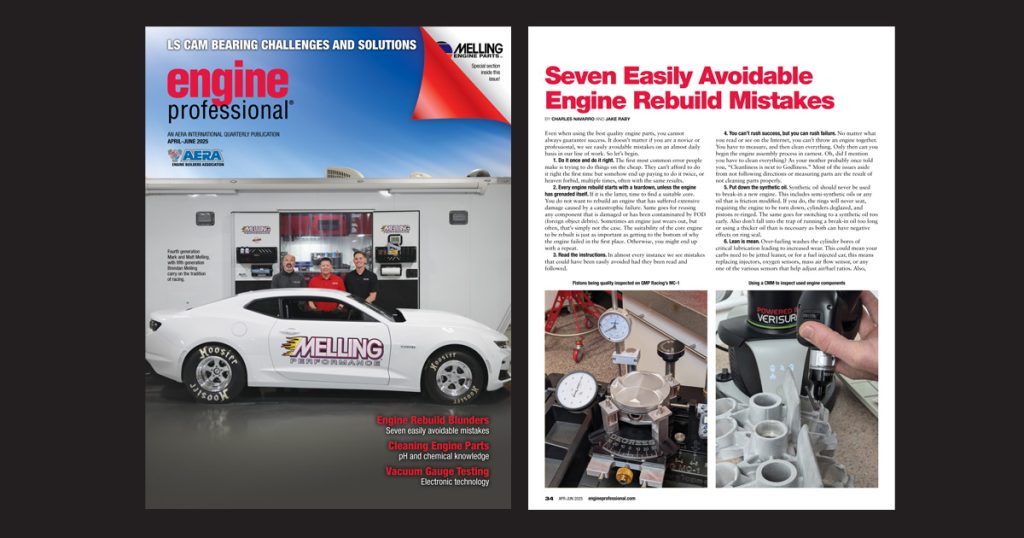
By Charles Navarro and Jake Raby
Even when using the best quality engine parts, you cannot always guarantee success. It doesn’t matter if you are a novice or professional, we see easily avoidable mistakes on an almost daily basis in our line of work. So let’s begin.
Read this article with all images in the digital issue of Engine Professional magazine https://engineprofessional.com/2025EPQ2/#p=36
- Do it once and do it right. The first most common error people make is trying to do things on the cheap. They can’t afford to do it right the first time but somehow end up paying to do it twice, or heaven forbid, multiple times, often with the same results.
- Every engine rebuild starts with a teardown, unless the engine has grenaded itself. If it is the latter, time to find a suitable core. You do not want to rebuild an engine that has suffered extensive damage caused by a catastrophic failure. Same goes for reusing any component that is damaged or has been contaminated by FOD (foreign object debris). Sometimes an engine just wears out, but often, that’s simply not the case. The suitability of the core engine to be rebuilt is just as important as getting to the bottom of why the engine failed in the first place. Otherwise, you might end up with a repeat.
- Read the instructions. In almost every instance we see mistakes that could have been easily avoided had they been read and followed.
- You can’t rush success, but you can rush failure. No matter what you read or see on the Internet, you can’t throw an engine together. You have to measure, and then clean everything. Only then can you begin the engine assembly process in earnest. Oh, did I mention you have to clean everything? As your mother probably once told you, “Cleanliness is next to Godliness.” Most of the issues aside from not following directions or measuring parts are the result of not cleaning parts properly.
- Put down the synthetic oil. Synthetic oil should never be used to break-in a new engine. This includes semi-synthetic oils or any oil that is friction modified. If you do, the rings will never seat, requiring the engine to be torn down, cylinders deglazed, and pistons re-ringed. The same goes for switching to a synthetic oil too early. Also don’t fall into the trap of running a break-in oil too long or using a thicker oil than is necessary as both can have negative effects on ring seal.
- Lean is mean. Over-fueling washes the cylinder bores of critical lubrication leading to increased wear. This could mean your carbs need to be jetted leaner, or for a fuel injected car, this means replacing injectors, oxygen sensors, mass air flow sensor, or any one of the various sensors that help adjust air/fuel ratios. Also, in this day and age, with modern ethanol enriched fuels, it is safer to install new injectors rather than sending the originals out to be cleaned.
- Drive it like you stole it. When breaking in a freshly rebuilt engine, it is important to put a load on the engine as soon as possible, varying speeds and loads. Thermal cycles are also important, so during the break-in process be sure not to get the engine oil or coolant too hot and give the engine an opportunity to cool off completely between break-in runs. The best way to break-in an engine is on the dyno, but if that’s not an option, find an open road and do repeated sessions of engine braking. However this doesn’t mean you should run the engine up to redline. Using different gears, allow the engine to slow down the car and then repeat. Varying engine speed and load aide in seating the piston rings.
With these generalizations out of the way, let’s get into specifics.
Another issue that is really easy to prevent are damaged piston rings. Although thin modern piston rings are made out of stronger materials, it is still possible to damage them, unless you use a tapered sleeve ring compressor. They are relatively inexpensive, however you need one for each and every bore size, but if you’ve ever damaged a ring during piston installation, or worse yet, discovered you have a problem after you’ve installed and run the engine, you’ll agree it is money well spent.
Depending on what engine you are rebuilding, it’s important to research known issues so that you can address them during the rebuild process. Beyond knowing how to properly recondition parts, which ones to upgrade, and making sure you measure and clean everything correctly, it is equally important to know when you need help. That includes knowing which parts can safely be reused and which ones need to be replaced, as well as whether or not OEM or Genuine is acceptable or if upgraded aftermarket components should be used instead.
The important thing is to take your time and be methodical. This starts with teardown. We use a bag and tag method and urge taking as many photos as possible or even take videos to document the parts and process. Inspecting each and every part as it comes off can tell you a lot about an engine and sometimes is necessary to determine why and how an engine failed in the first place and how to prevent future failures. Taking these simple but critical steps can ensure success in your engine rebuilding endeavors.
Read this article with all images in the digital issue of Engine Professional magazine https://engineprofessional.com/2025EPQ2/#p=36